I. Start with the Fuel Gas: Three Gases, Three Constraints
- Natural gas: stable, but dependent on pipeline conditions
Pipeline natural gas usually runs above 90% methane, with high heating value and stable composition, so chemical-corrosion risk to the engine is low. Its reliability, however, depends on the pipeline network: the stability of inlet pressure and the swing of heating value are the main considerations in sizing. Insufficient supply pressure reduces output; when heating-value fluctuation exceeds the adjustment range of the air-fuel ratio (AFR) control, knock or abnormal exhaust temperature follows. Moreover, knock resistance should be judged by the Methane Number rather than methane percentage alone: pipeline gas scores high and stable, whereas blended or alternative gases must be checked individually, or a lean-burn engine will misfire or knock on the lower-grade gas.
- Biogas: fluctuating composition, with hydrogen sulfide
Biogas from anaerobic digestion typically holds only 50%–70% methane and varies day to day with feedstock and temperature; low energy density means the set needs a larger intake path. The more critical issue is hydrogen sulfide (H₂S): in the presence of water, the acid it forms after combustion corrodes cylinders, piston rings, and the exhaust system, manifesting as low-temperature dew-point corrosion and high-temperature sulfidation. Desulfurization and dehydration pretreatment are therefore mandatory for biogas sets, and oil formulation and change intervals must be re-established for the sulfur load.
- Landfill gas: siloxane deposits and low-heating-value derating
Landfill gas runs even lower on methane, commonly 30%–50%, with low heating value and a complex mix. The constituent to watch hardest is siloxanes—silicon compounds from personal-care products that oxidize in the hot combustion chamber into hard silicon-dioxide (SiO₂) particles, abrading spark plugs, valves, and cylinder walls like an abrasive while accelerating wear and degrading the oil. In addition, because landfill gas is low in heating value, a standard set often cannot reach its nameplate rated power and must run derated after a thermodynamic conversion based on the gas analysis report—the actual available power has to be calculated.
II. Rating Class and Site Derating
III. Match the System to the Gas
- Fuel supply: sets burning landfill gas or biogas need larger pressure regulators, mixers, and pipe diameters than a natural-gas system, to meet volumetric-flow demand.
- Materials and corrosion protection: against H₂S, piston rings and valve seats use corrosion-resistant coatings or special alloys; against siloxanes, beyond front-end activated-carbon adsorption or cooling separation, the back end usually needs more frequent carbon cleaning.
- Thermal management: gas engines already run at high exhaust temperature, and burning high-impurity gas loads the intercooler and cooling system harder, so the cooling margin must be recalculated.
IV. Match the Set to the Site
- Continuous base load and fluctuating load
In mines, plants, and microgrids serving as base-load power, the load curve often swings widely. A single large set running at low load for long periods suffers degraded combustion and increased carbon buildup (the “wet stacking” operators know well), and a single-point failure blacks out the whole plant. From a system-architecture standpoint, multi-unit paralleling is the more sound choice: it provides redundancy and lets the operator add or drop units with real-time load, keeping each engine in its 60%–80% optimal band and balancing economy with mechanical life.
- Physical deployment in harsh environments
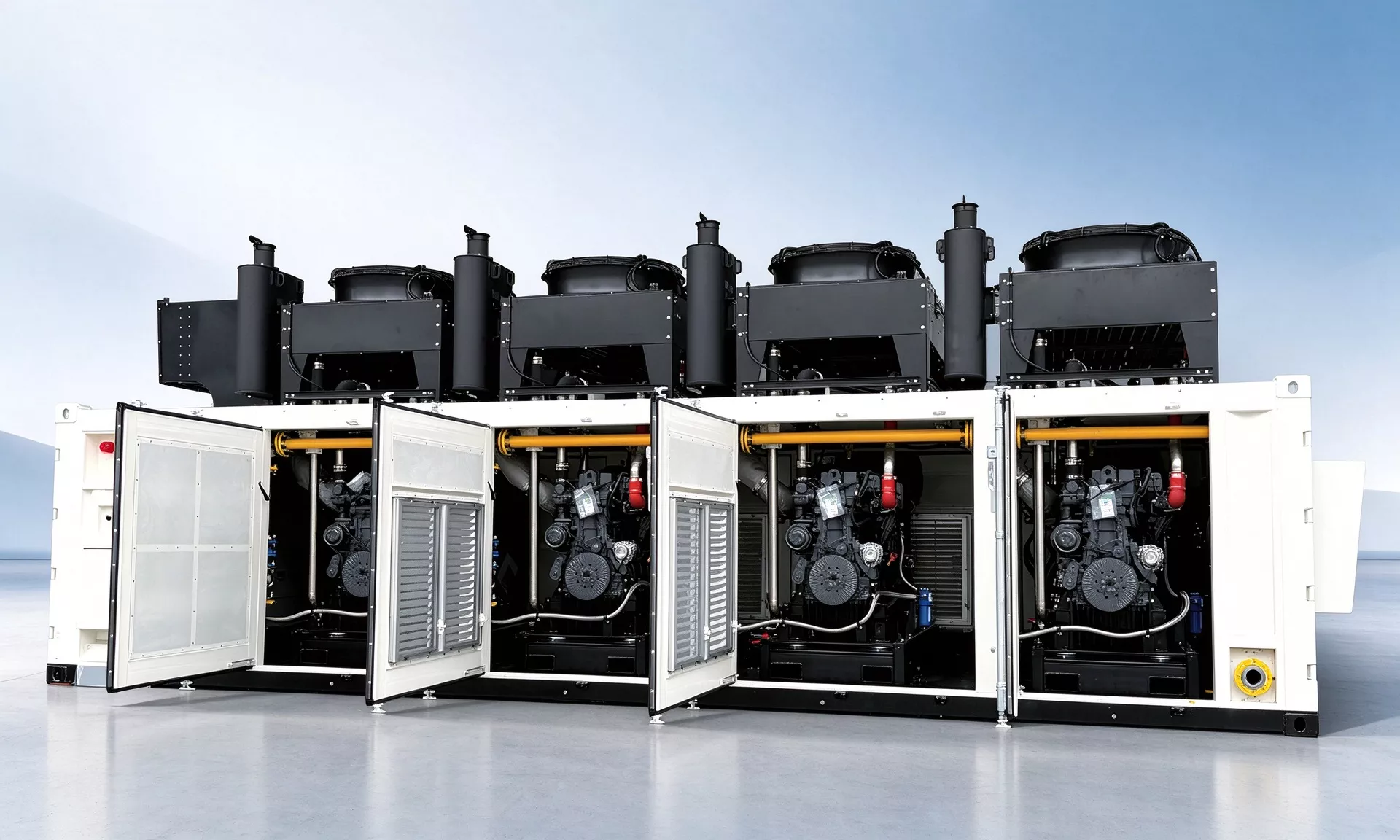
Remote mines, deserts, or cold regions lack a ready-made plant, so a containerized acoustic enclosure is the preferred option—providing both a dust-, sand-, and weather-resistant physical barrier and reduced noise radiation. At the same time, harsh environments raise the bar for thermal management: a standalone external radiator module or a split layout prevents hot-air recirculation and keeps coolant temperature stable at high ambient.
- Acoustic and electrical isolation in sensitive areas
In hospitals, commercial centers, or residential areas, unit start/stop and operation are bound by strict environmental and noise regulations. For such sites, the silencing structure (impedance-composite silencer, labyrinth intake/exhaust path) must be fully implemented. As emergency power, beyond millisecond-level ATS transfer with the utility, electrical interlock protection and remote monitoring are required to ensure safe auto-start and fault isolation when unattended.